





SOCIAL SCIENCE AND HUMANITIES
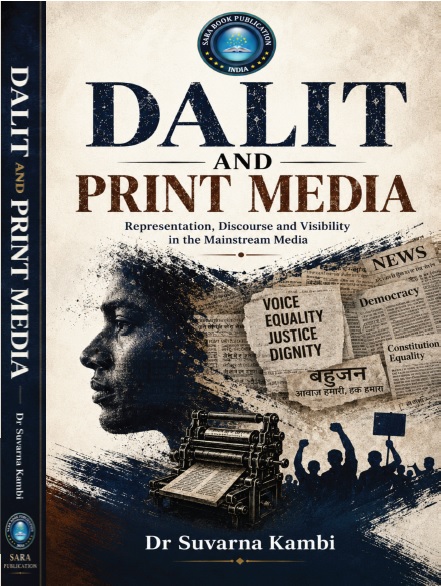
Dalit And Print Media
by Dr. Suvarna Kambi
ISBN Number : 978 - 81 - 966319 - 1 - 8
Authors Details
| Author Name | Image | About Author |
|---|---|---|
| Dr. Suvarna Kambi |  |
Dr Suvarna S. Kambi is a faculty member in the Department of Journalism and Mass
Communication, Kodagu University, Kodagu, Karnataka, India. She was awarded a
Doctoral Fellowship by the Indian Council of Social Science Research (ICSSR), New
Delhi (2017–2018) and qualied for the Karnataka State Eligibility Test (K-SET) in 2017.
She has published nine research articles in reputable national and international journals,
including those indexed in the UGC-CARE list, and has contributed chapters to edited
volumes with ISBNs. She has also presented more than ten papers at national and
international conferences. In addition to scholarly publications, she has authored over 150
articles and features in leading newspapers, magazines, and digital platforms. Dr Kambi
was honoured with the International Outstanding Teacher Award–2025 by the International
Multidisciplinary Research Foundation. She has been serving as a member of the editorial
board of the Edwin Group of journals since 2024. Her research and teaching interests
include print media studies, translation, news reporting, editing, graphic design, Dalit
studies and media, and media practice. She has held key academic and media coordination
roles, including media reporting, media house coordination, mentorship of Mahila Dhwani
E-paper and Akka TV, and social media management at Karnataka State Akkamahadevi
Women's University, Vijayapura. She has professional prociency in Adobe InDesign,
Photoshop, Illustrator, Premiere Pro, Sound Booth, Final Cut Pro, Adobe Audition, and
Audacity. |
Book Description
The structure of Hindu social requests is variously levelled in nature, and 82 per cent of the Indian populace is Hindu as per 2011 Statistics. The root of the Hindu Social Request is the holy text of the Hindus, the Rigveda. The tenth section (91st Song) of this content uncovers that there are four gatherings, also called Varna. These gatherings are organised at various levels, one over the other. “The rst gathering, Brahmin, involves the top situation in this chain of command. The subsequent gathering is Rajanya (later known as Kshatriyas), and the third is Vaishya. The Shudras come toward the end in the chain of command, as indicated by the Rigveda. Along these lines, the book's perspective on the Hindu social hierarchy delineates only four Varnas (classes). However, anthropologists and sociologists have incorporated a bunch of the Ashprishyas (abstract deciphered as untouchables), otherwise called Dalits in the Hindu Social Order” (Kumar, 2014). Hence, the full plan of the Hindu social hierarchy comprises various signicant social gatherings organized hierarchically, with Brahmins at the top and Dalits at the lowest level.


